Power lines in tree and electrocution death

by electroc on September 4, 2011

Another electrocution accident death happened on September 3, 2011 in Takoma Park, Maryland. The electrocution accident involved electrical power lines running near or through a tree in a residential neighborhood. A man was trimming a tree that had grown around high voltage power lines.

News articles say that the power line was at 7,620 volts. Many power lines running through residential areas have voltage that is higher and more dangerous than the 220 volts that comes into the homes.

The police are quoted as saying the electrocuted worker was trying to take down the aluminum ladder he had been using to get up into the branches.

The ladder probably made contact with the uninsulated high voltage line, or perhaps a tree branch conducted the electricity to the ladder. The current through his body killed him.

News articles with more information

A video that appears to show how the tree had grown all around the power lines is at

http://www.nbcwashington.com/news/local/129184968.html

Another news article with photographs of the tree with power lines in the branches is at

http://hyattsville.patch.com/articles/update-hyattsville-man-fatally-electrocuted-on-jackson-avenue

From the photographs, it seems that the tree may have been in the right of way next to the public street, but no survey information is available as of when this post is written.

Electrical utilities have obligation to maintain tree clearance

Electrical power utilities have an obligation under many state public utility regulations to keep trees cut back from high voltage power lines, because of the great danger to people working and to children tempted to climb trees. See the post about tree growth and power lines. When the Maryland rules on this are determined, this blog post will be updated.

One of the news articles cited above says that PEPCO, an electric utility, had responded. A housing subdivision in the same county, Chevy Chase Village, has on its website an undated article that comments on the tree pruning of the electrical utility PEPCO:

PEPCO Tree Pruning

In response to recent criticism for poor performance, the Maryland Public Service Commission has mandated that PEPCO conduct thorough reliability upgrades. This effort will include aggressive, but responsible, tree pruning around the power lines.

Mr. Orlando Hernandez, the electrocuted worker, is said to have left a wife and children. Our sympathy to them in their time of grief.

Please avoid aluminum ladders, use fiberglass ladders for safety. Even a careful person can slip, and you may not see an electrical wire hidden by tree branches.

{ Comments on this entry are closed }

Worker Death Results in OSHA Citation

by electroc on July 7, 2011

On July 5, 2011, OSHA stated that it has cited a Mississippi employer, Howard Industries Inc., for serious safety violations after a worker was electrocuted in January. Proposed penalties for the citations total $169,500.

The serious violations included

  • not requiring employees to use work safety practices when dealing with live electrical circuits,
  • failing to use locks and tags when de-energizing test equipment, and
  • failing to develop specific lockout/tagout procedures.

(This office has pending an on-the-job electrical injury case that was caused by a separate subcontractor’s failure to follow proper lockout/tagout procedures.)

There were other violations. According to OSHA, a “serious violation” occurs when there is substantial probability that death or serious harm could result from a hazard about which the employer knew or should have known.

There were also repeat violations, including

  • failing to provide machine guarding on the press brake and the welder, noncombustible welding screens for employees, and
  • flexible cords instead of fixed wiring.

A repeat violation exists when an employer previously has been cited for the same or a similar violation of a standard, regulation, rule or order at any other facility in federal enforcement states within the last five years. The company was cited for all four of these same violations at its Laurel plant in June 2009.

Clyde Payne, OSHA’s area director in Jackson, said “It is the employer’s responsibility to ensure that workers are trained and provided the appropriate protective equipment so they can perform their duties safely.”

The procedure allows the company 15 business days to comply, request a conference or contest the findings.

On-the-job injuries are more common than necessary. Employers, and those that act in concert with employers such as general contractors, have an obligation to provide a safe work place. A breach of this duty may give a claim under the Employer Liability Law in addition to the workers compensation claim.

{ Comments on this entry are closed }

Risk of Electrocution in Non-Electrician Jobs

by electroc on May 23, 2010

The risk of an electrocution accident is well known to electricians and those who work on high voltage electric lines. However, a published study, written by engineers from the Centers for Disease Control, analyzed data from the Bureau of Labor Statistics and found that other jobs, such as construction laborers, groundskeepers and gardeners, truck drivers, and farmers, also have the danger of electrical burns.

Data in the study is from 1992 through 2002. The study discusses the particular level of danger in the construction industry. Construction job site accidents that resulted in death were mostly from contact with overhead power lines. These accidents were often a result of hand-held tools or equipment, such as aluminum ladders. Other construction site electrical injuries were from contact with wiring or components. Wiring or grounding problems were typical causes of non-fatal injuries.

The study is available online at Trends in Electrical Injury.
{ Comments on this entry are closed }

Employers are required to provide a safe workplace. The Occupational Health and Safety Act of Canada has this requirement set out

Duties of employers
25.  (1) An employer shall ensure that,

(c) the measures and procedures prescribed are carried out in the workplace;

(2) Without limiting the strict duty imposed by subsection (1), an employer shall,

(h) take every precaution reasonable in the circumstances for the protection of a worker…

Ontario Power Generation Inc. violated this requirement, and a worker was injured by burns from an arc flash. The company pleaded guilty and was fined $100,000. The conviction was under OHSA, Section 25(2)(h).

This is the description of what happened from the government website.

“On January 15, 2008, two maintenance workers at the company’s Atikokan operating station were called to examine some malfunctioning equipment. The equipment was locked in a chamber to protect workers from its electrically energized, moving apparatus.  A lockout system required equipment to be electrically de-energized, grounded and locked out before the chamber could open.  An equipment operator used a bypass key to circumvent the lockout system and open a hatch door while the equipment was still energized. One of the workers shone a flashlight into the open door, causing an arc flash of electricity.  The arc flash burned the worker’s hand, arm and chest.

A Ministry of Labour investigation found that the key used to bypass the lockout system was available to workers.

Ontario Power Generation Inc. pleaded guilty to failing to take the reasonable precaution of preventing ready access to the means of circumventing the lockout system.”

Based on the description, it seems that the company did not enforce a safety rule of not bypassing the lockout without adequate supervision. Perhaps a supervisor standing by would have prevented using the flashlight, and the electrical injury on the job would have been prevented. For more information about employer’s safety duties under United States law see construction accident injuries or the new personal injury website page by a construction accident attorney.

{ 0 comments }

Serious electrical injuries were the result when an aluminum ladder contacted electric power lines during a roofing job. If any power lines are near the job, fiberglass ladders should be used. A brief article about the injuries, with a picture showing the power lines near the building, can be seen at WTNH Channel 8 web article.

The second picture in the series shows how the power lines were near the building. According to news articles, OSHA is investigating.

{ 0 comments }

Virginia county employee electrocuted on the job

by electroc on December 4, 2009

The evening before Thanksgiving, a county worker from the water department in Arlington, Virginia lost his life as he was helping to repair a broken water main. This video has touching comments from his co-workers.

On the job injuries make up many of the electrical accident injury problems. Electrical wires are more dangerous around construction or repair activity. May this departed worker rest in peace.

{ 0 comments }

Contractor cited by OSHA for Electrocution Hazard

by electroc on November 11, 2009

The owner of this site has a personal injury website, with a construction injury attorney page that comments about the Employer Liability Law. OSHA has cited a contractor for electrocution and fall hazards at a Westchester County, New York worksite. The information below, about significant construction job hazards, is from an OSHA news release dated November 9, 2009.

The Occupational Safety and Health Administration (OSHA) has proposed over $50,000 in fines against Metro Steel Fabricators Inc., a Brooklyn steel erection contractor, for alleged willful and serious violations of safety standards at a Tuckahoe, N.Y., jobsite.

OSHA’s inspection found that workers at the 30 Elm St. worksite were exposed to electrocution hazards while working within 10 feet of energized high-voltage power and service lines, while workers who were connecting steel beams without fall protection were exposed to falls of three stories.

“Falls and electrocutions are among the leading causes of death in construction work,” said Diana Cortez, OSHA’s area director in Tarrytown, N.Y. “Electricity can kill or injure instantly, while a momentary slip, trip or loss of balance can lead to a fatal or disabling plunge. There is no good reason for an employer’s failure to provide these basic, commonsense and legally required safeguards at each and every jobsite.”

The inspection also found that Metro Steel Fabricators was erecting steel without first receiving written verification that concrete footings were of sufficient strength to support the loads; a roadway workzone was improperly set up and lacked warning signs to tell motorists of a flagger and a crane in the roadway; and additional fall hazards stemmed from lack of perimeter safety cables and use of an incomplete stairway for access.

OSHA has issued Metro Steel Fabricators one willful citation, with a proposed fine of $35,000, for the electrocution hazard and seven serious citations, with $15,600 in fines, for the remaining items. OSHA defines a willful violation as one committed with plain indifference to or intentional disregard of employee safety and health. Serious citations are issued when death or serious physical harm is likely to result from hazards about which the employer knew or should have known.

“One means of preventing hazardous conditions is to establish an effective safety and health management system through which employers and employees work together to proactively evaluate, identify and eliminate hazards,” said Robert Kulick, OSHA’s regional administrator in New York.

Metro Steel Fabricators has 15 business days from receipt of its citations and proposed penalties to comply, meet with OSHA or contest the findings before the independent Occupational Safety and Health Review Commission. The inspection was conducted by OSHA’s Tarrytown Area Office; telephone 914-524-7510.

Under the Occupational Safety and Health Act of 1970, OSHA’s role is to promote safe and healthful working conditions for America’s men and women by setting and enforcing standards, and providing training, outreach and education. For more information, visit http://www.osha.gov. For information about how on the job injuries may result in a claim in addition to the workers compensation claim, you may want to visit this article about the Employer Liability Law.

{ 1 comment }

Tree experts and power line cases

by electroc on May 3, 2009

When trees grow up near electrical power lines, injury or death can result. Many electrical injury cases happen because trees were allowed to grow too close to power lines. An issue in such a case is whether the electric power utility complied with the safety rules. Each state has safety rules about keeping the trees cut away from the high voltage lines.

Recently, John Sevier, a tree expert and Certified Arborist in California, graciously provided this site with a citation to the minimum distance rules in California. Those California rules provided by Mr. Sevier are cited in the tree growth and electric power lines page. Mr. Sevier has testified in court and in the legislative process about tree safety issues. His information is appreciated.

In an electrical injury case involving the specific tree clearance standard of care, the attorney will usually retain an expert. The expert will advise the attorney about which standards the state officials would expect the power company to have followed, how the state officials interpret their policies (the states vary on how strict they are) and whether the documents show that the power company was in compliance with the standards.

{ 0 comments }

Tree Grew Around Power Lines, Child Electrocuted

by electroc on September 24, 2008

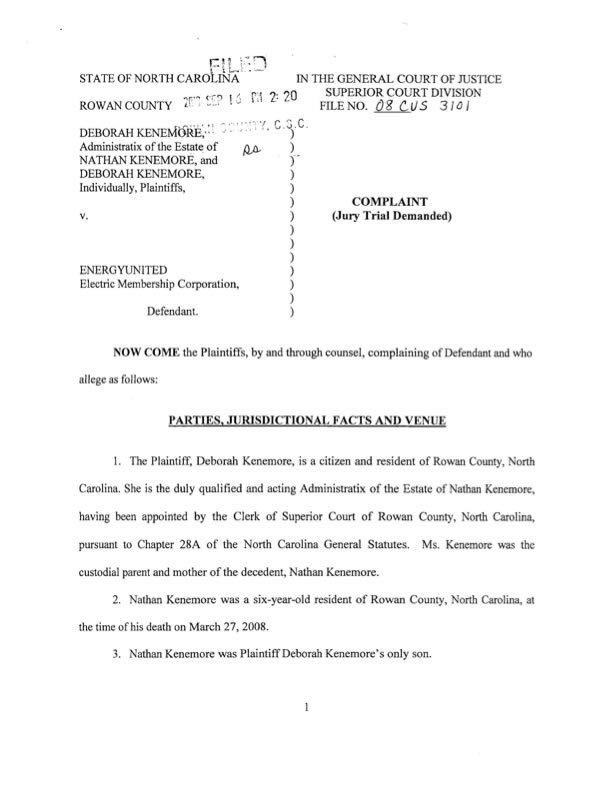
Recent North Carolina case: Kenemore v EnergyUnited.

North Carolina lawyers recently filed this lawsuit. As set out in the Complaint, a pine tree in a residential back yard grew over the years up and around an electric power line. A six year old neighbor boy from next door was visiting with his mother. He and the six year old girl who lives in the house went outside to play in the yard, and the boy climbed the tree. The little girl playing with him came into the house and told the boy’s mother that the boy was pretending to be asleep up in the tree.

The mother went out and called up to her son, who did not move, so she climbed the tree to his limp body, screaming his name. An ambulance took her son to the hospital, but he was dead from electrocution.

There was a 7,200 volt uninsulated electric power line running through the tree or near enough to reach. The 6 year old boy had no idea of the danger.

complaint as filed page 1

Complaint as filed, page 1

As readers of this website know, there are electrical safety standards to protect people from the danger of high voltage electric power lines. The National Electrical Safety Code requires the electric power utility companies to keep tree branches cut back from their power lines, to prevent just this sort of accident. It appears from the Complaint that a violation of the National Electrical Safety Code caused the death of an innocent victim.

For a copy of the Complaint as filed in the Court, in Adobe pdf format, click here. But be warned, reading the Complaint will bring tears to your eyes.

My sympathy to the family and friends and neighbors of the boy who was killed.

Update: This case was settled, by the power company making a substantial payment.

For more information about safety standards of keeping trees cut back from power lines, visit the page on trees near power lines.

{ 0 comments }

Trial in Scotland about Death of Electrician

by electroc on September 17, 2008

An unfortunate electrician was on the job pulling cable in a false ceiling, when he died from electrical shock because he touched a cable. The cable had been marked “not in use” but it was in fact connected.

A contractor and three of its employees are facing charges:

“The charges include failing to provide a safe system of working, training, supervision, risk assessment and resources; failing to test circuits and wires into a distribution board before they were made live; and failing to ensure the board was not live while employees worked on circuits connected to it.”

The defendants deny the charges. The trial is expected to last 3 weeks. The BBC news story is available here.

{ 3 comments }

Web Analytics